

I first became interested in rock stacking during our trip to Technorama, the Swiss Science Center. Thorsten Künnemann, their Executive Director took us on a marvelous tour of Zurich. As we walked along the shore of Lake Zurich, we came to an area that was filled with amazing stacks of balanced rocks. When you first see them, you think that they must be held together with glue or mud. Only when you get very close can you see that it is all a matter of balance. Since then, we have seen similar stacks in other places and made some of our own.
If you would like to try rock stacking, you will need:
- a flat, stable surface
- a variety of rocks or other things to stack
- steady hands
- lots of patience
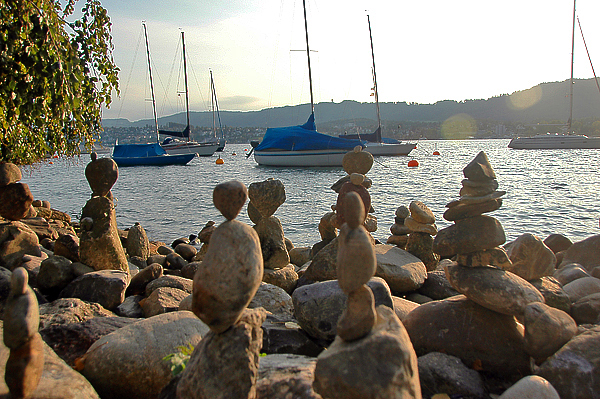
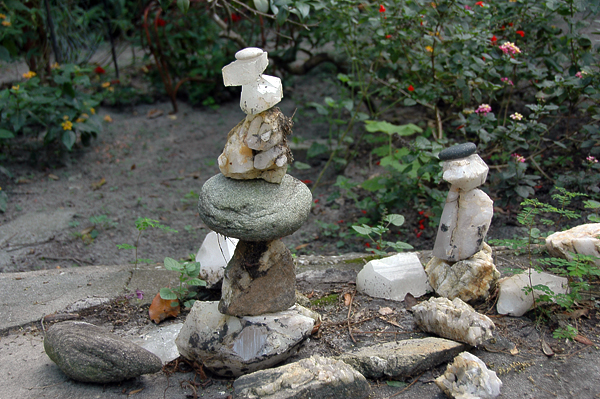


While at first rock stacking may seem like a frivolous activity, there is actually quite a bit of science and engineering involved. As we saw in the Science of Balance video, we can balance an object by keeping its center of gravity (its balancing point) directly above its base (the part of the object that is supporting it.)
To start, you need a wide variety of rocks, or other objects to stack. If you don't have lots of large rocks, you might try stacking toys, stuffed animals, or other irregularly shaped objects that are not breakable.
Select a large, steady rock as your foundation. You want the rock on the bottom to be very stable, because if it wobbles, your entire stack will wobble, which usually means that it all falls down. By using a wide, flat rock, it has a large base, which gives you plenty of working room to keep the center of gravity inside that base. While you are learning the art of rock stacking, you will have better success if you also choose a foundation rock that has a fairly flat top, to make it easier to balance the next rock.
It is easiest if you start simply, using fairly flat rocks to make stacking easier. Keep in mind that as you add each rock, you are adding pressure to the rocks under it, which may shift their center of gravity. Work slowly. Instead of putting a stone in place and releasing it, gradually let its weight rest on the stack, checking to see whether the stack remains stable.
Once you have the knack of stacking flat rocks, then you can start to get more creative and adventurous. Use rocks with unusual shapes, and try balancing them on smaller bases. Remember that a smaller base means you have to be more careful with the stack's center of gravity. Also remember that each rock can change the center of gravity of the entire stack, throwing the stones below it out of balance. If one orientation is unstable, try turning the rock to a different side. If that does not work, then try a different stone. The more you practice; the more you will learn about the art and science of stacking rocks.